 Image 1 of 3
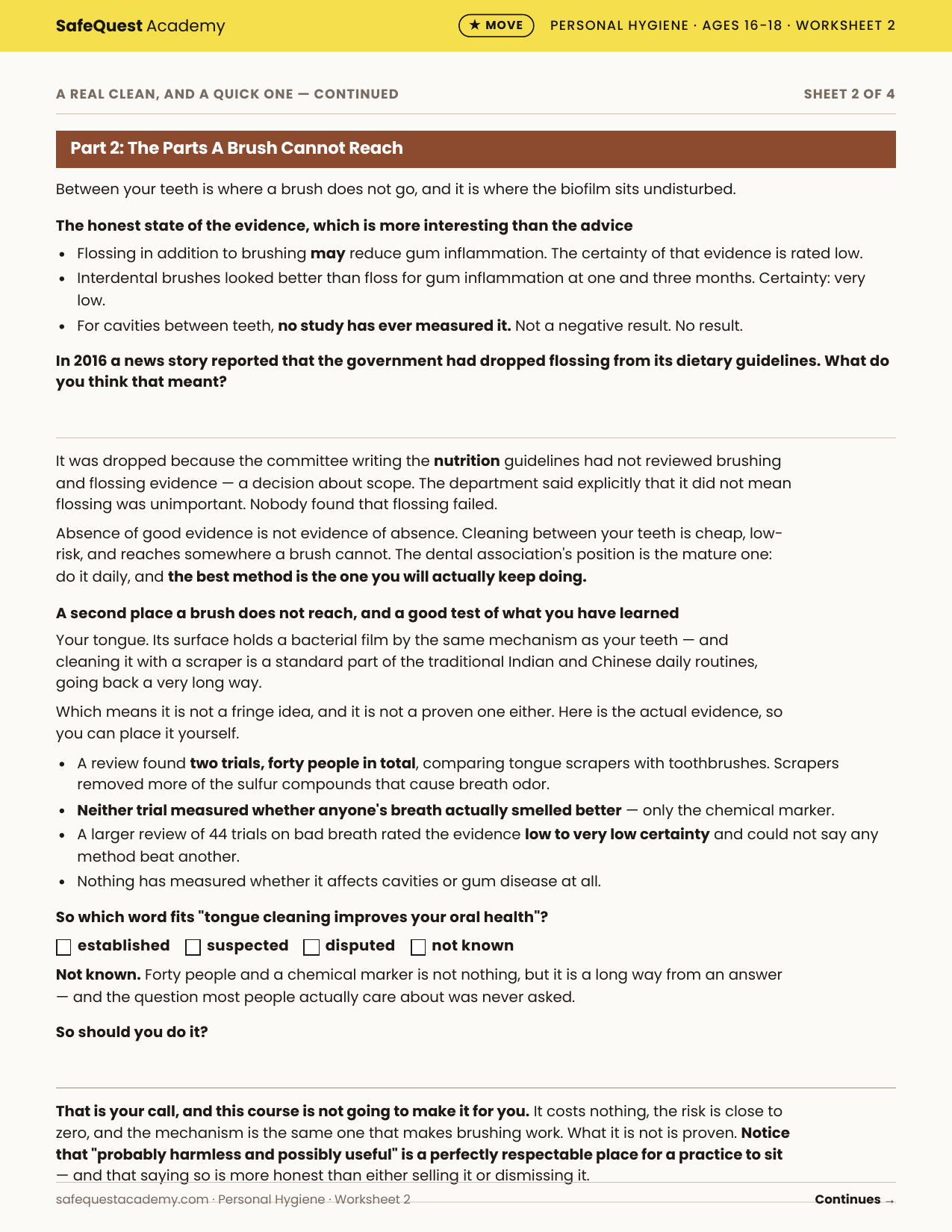 Image 2 of 3
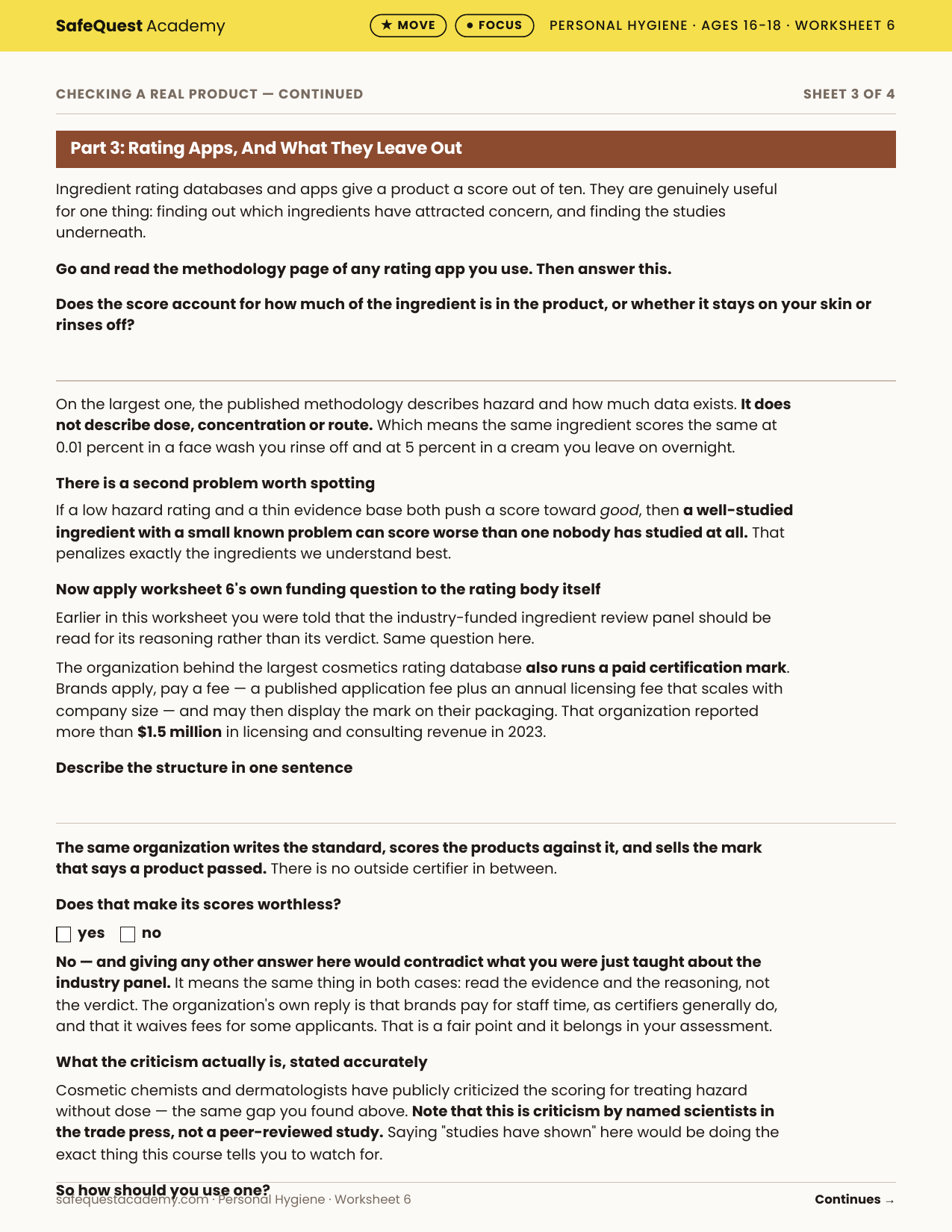 Image 3 of 3
7 worksheets, 27 pages · parent guide, 7 pages
Almost everything a teenager has been told about hygiene is a rule -with the reason removed.
This course puts the reason back, because a mechanism you understand generates the rules, and a rule you memorized generates nothing.
The spine of it is one distinction: hazard is what a substance can do. Risk is the chance it does it to you.
Almost every frightening claim about a personal care product lives in the gap between those two words.
What's inside:
· What Plaque Actually Is — biofilm, the acid mechanism, and why the pH falling below about 5.5 is the event that matters. Your teenager works out for themselves why sipping a soda for three hours beats drinking it in five minutes for damage done. Plus what fluoride is really doing, which is not what most people were taught
· A Real Clean, And A Quick One — done at a sink. Brushing timed honestly, the actual state of the flossing evidence, why soap removes rather than kills, and the story of the same molecule that failed the evidence test in soap and passed it in toothpaste
· Reading The Back Of The Bottle — descending order, and the 1 percent line below which the order is arbitrary. The federal rule that lets one word stand for a mixture. The terms with no definition behind them, in FDA's own words
· Hazard And Risk — four questions to ask about any harm claim, worked through on a real example where the alarming version and the accurate version point at two completely different risks
· The Ones Worth Knowing About — PFAS, phthalates, parabens, period products. Each with the certainty named out loud: established, suspected, disputed, or simply not known
· Checking A Real Product — a five-step method run on something from your own bathroom, and every source ranked with its limitation stated
· My Routine — the effect sizes side by side, a routine built to survive a bad week, and what is worth saying out loud to an adult.
Every regulatory and scientific claim in this course is a specific, checkable fact with a date on it, not a general statement. Where a rule was required but had not been published, the course says so and gives the deadline, so your teenager can go and check rather than trust a page.
Every file is a PDF.
Fill them in on a computer, or print them. You get both editions — full color, and a print-friendly version that uses about half the ink.
Same words, same pages. Print whichever suits the day.
Every course includes a parent guide written for that age, and a short page on how to practice the material so it is still there next year.
One purchase covers your own family. Print as many copies as you need for your own children.
Two children at the same age level? One purchase is enough.
Two children at different age levels? Each age is genuinely different material.
Using an Arizona ESA?
Place a separate order per student, so each receipt matches that child.
Prices shown are before tax. Any tax due is calculated at checkout
7 worksheets, 27 pages · parent guide, 7 pages
Almost everything a teenager has been told about hygiene is a rule -with the reason removed.
This course puts the reason back, because a mechanism you understand generates the rules, and a rule you memorized generates nothing.
The spine of it is one distinction: hazard is what a substance can do. Risk is the chance it does it to you.
Almost every frightening claim about a personal care product lives in the gap between those two words.
What's inside:
· What Plaque Actually Is — biofilm, the acid mechanism, and why the pH falling below about 5.5 is the event that matters. Your teenager works out for themselves why sipping a soda for three hours beats drinking it in five minutes for damage done. Plus what fluoride is really doing, which is not what most people were taught
· A Real Clean, And A Quick One — done at a sink. Brushing timed honestly, the actual state of the flossing evidence, why soap removes rather than kills, and the story of the same molecule that failed the evidence test in soap and passed it in toothpaste
· Reading The Back Of The Bottle — descending order, and the 1 percent line below which the order is arbitrary. The federal rule that lets one word stand for a mixture. The terms with no definition behind them, in FDA's own words
· Hazard And Risk — four questions to ask about any harm claim, worked through on a real example where the alarming version and the accurate version point at two completely different risks
· The Ones Worth Knowing About — PFAS, phthalates, parabens, period products. Each with the certainty named out loud: established, suspected, disputed, or simply not known
· Checking A Real Product — a five-step method run on something from your own bathroom, and every source ranked with its limitation stated
· My Routine — the effect sizes side by side, a routine built to survive a bad week, and what is worth saying out loud to an adult.
Every regulatory and scientific claim in this course is a specific, checkable fact with a date on it, not a general statement. Where a rule was required but had not been published, the course says so and gives the deadline, so your teenager can go and check rather than trust a page.
Every file is a PDF.
Fill them in on a computer, or print them. You get both editions — full color, and a print-friendly version that uses about half the ink.
Same words, same pages. Print whichever suits the day.
Every course includes a parent guide written for that age, and a short page on how to practice the material so it is still there next year.
One purchase covers your own family. Print as many copies as you need for your own children.
Two children at the same age level? One purchase is enough.
Two children at different age levels? Each age is genuinely different material.
Using an Arizona ESA?
Place a separate order per student, so each receipt matches that child.
Prices shown are before tax. Any tax due is calculated at checkout